

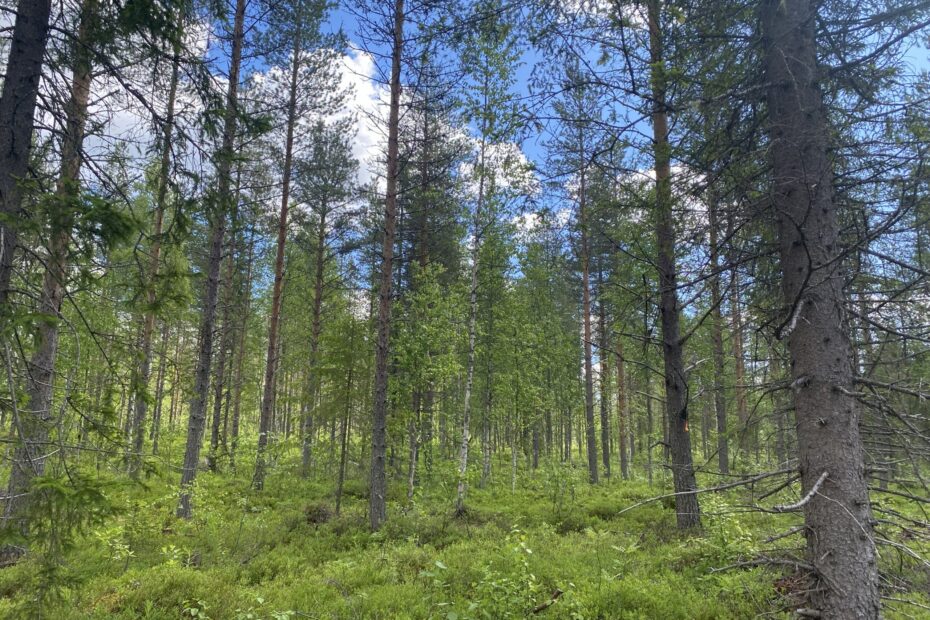
Petra Peltola’s doctoral research demonstrates that the natural regeneration of Scots pine and Norway spruce in continuous cover forestry is most successful when stand density and harvesting methods support seedling establishment and growth.
Doctoral research by Petra Peltola examined the natural regeneration of Scots pine and Norway spruce under continuous cover forestry (CCF) in Finland. The study explored how different harvesting methods and stand conditions affect seedling establishment and growth, providing new knowledge to support the sustainable implementation of CCF.
The results showed that regeneration and seedling growth were generally strongest under a sparser tree canopy, in some cases at lower stand densities than current silvicultural recommendations suggest. For Scots pine, site conditions such as exposed humus and site preparation enhanced regeneration, while small gap cuttings proved particularly effective in promoting new seedlings.
The findings can help forest managers select harvesting methods, stand densities and regeneration practices that improve natural regeneration success. The research also demonstrated that remote sensing data can be used to predict naturally regenerated seedling densities, offering new opportunities for forest monitoring and management.
Read more and follow the Doctoral defence (11 September 2026).
The research project is part of UNITE, a flagship of the Research Council of Finland, which studies and develops the forest-human-machine interplay.