

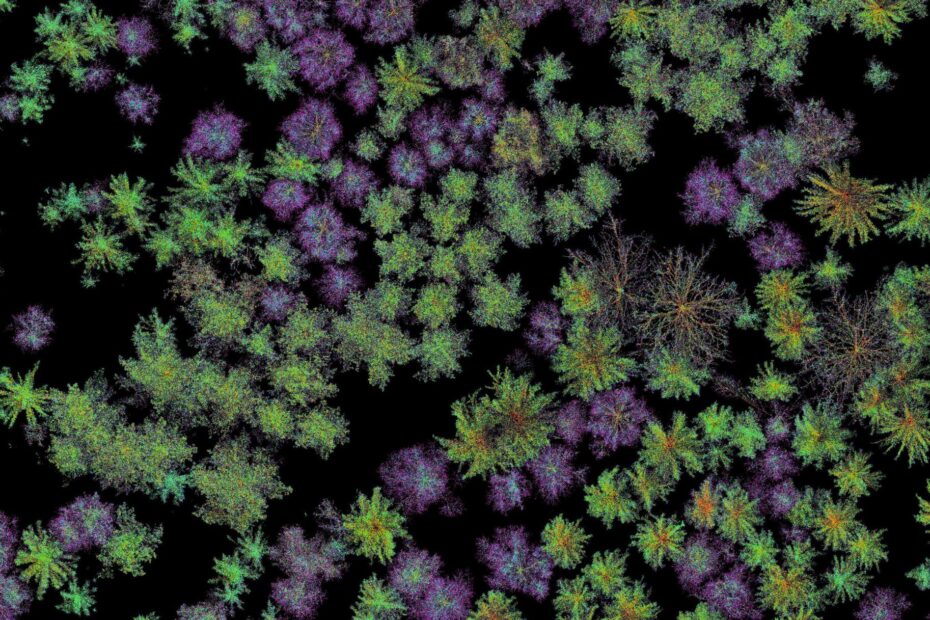
In a recent study, multi-channel laser scanning and deep-learning methods correctly identified tree species from a distance. This method, developed by researchers at the Finnish Geospatial Research Institute FGI, can identify remotely surveyed trees more comprehensively and quickly than before, which opens up significant opportunities for monitoring forest productivity and biodiversity.
There is a need for accurate information about forests. Information is what allows forest owners, authorities and decision-makers to make more economically viable and ecologically sustainable decisions. As part of a study funded by the Academy of Finland and the EU, researchers from the Finnish Geospatial Research Institute FGI, in cooperation with researchers from several universities, develop new methods for identifying individual tree species.
The methods presented in this fresh scientific article are particularly well suited for quicker and more comprehensive production of high-quality reference materials about tree species compared to previous methods. The best results of this method were gained from highly dense laser scanning data, through deep learning, which identified nine tree species: pine, birch, spruce, aspen, rowan, alder, oak, linden and maple. The average identification accuracy of these trees was 92%. The new method also improved accuracy in sparser datasets.
Accuracy of multi-channel laser scanning close to aerial image accuracy
– During the last 15 years, the production of data on forest resources has moved to a method that uses laser scanning, aerial photographs and plot data measurements. However, it had been difficult to interpret tree species from the data, until now. The results of the study were partly in line with expectations, meaning that the accuracy of multi-channel laser scanning is close to the accuracy of aerial photography. It proves that machine and deep learning methods can improve accuracy,” says Professor Markus Holopainen from the University of Helsinki.
– Multi-channel laser scanning is far better than previous methods at identifying small trees and deciduous tree species, which are crucial for biodiversity and regeneration in the forest. The results of the identification of tree species are encouraging for further development of the method, providing opportunities to scale the identification of tree species nationwide, says Senior Scientist Josef Taher from the Finnish Geospatial Research Institute FGI.
– It will be possible to use the laser scanning data collected by the National Land Survey as training material for deep and machine learning models, which the data can train to predict tree species across Finland, says Taher.
Accurate tree species information enhances forestry and protection of biodiversity
The climate and biodiversity goals of forestry require more accurate information on the structure and species composition of forests. Detailed information on tree species helps to make decisions based on that information.
– It is crucial to consider the economy, biodiversity and carbon balance simultaneously and take their effects taken into account. More accurate information on tree species is one way to achieve even better decision-making, says Markus Holopainen.
Photo: Antero Kukko, Finnish Geospatial Research Institute at the National Land Survey of Finland.
Additional information
Josef Taher, Senior Researcher, Finnish Geospatial Research Institute FGI firstname.lastname@maanmittauslaitos.fi
Professor Markus Holopainen, University of Helsinki firstname.lastname@helsinki.fi

Over the years, the research has been funded by the EU in Research Council of Finland’s ChistEra programme project 4Map4Health and the Research Council of Finland’s HPC Carbon project, as well as the Diversity4Forest project (funded from the European Union’s NextGenerationEU programme).
The research project is part of UNITE, a flagship of the Research Council of Finland, which studies and develops the forest-human-machine interplay.